
C++ 浮点数
学习C++ - C++浮点数
C++浮点类型表示具有小数部分的数字。
它们提供了更大的价值范围。
字面量
C++有两种写入浮点数的方式。
第一个是使用标准的小数点符号:
12.34             // floating-point
987654.12         // floating-point
0.12345           // floating-point
8.0               // still floating-point
第二种方法称为E符号,它看起来像这样:3.45E6。
这意味着值3.45乘以1,000,000。
E6表示10到6的幂,即1后跟6个零。
因此3.45E6是3,450,000。
6称为指数,3.45称为尾数。
这里有更多的例子:
1.12e+8             // can use E or e, + is optional
1.12E-4             // exponent can be negative
7E5                 // same as 7.0E+05
-12.12e13           // can have + or - sign in front
例子
下面的代码检查float和double类型。
#include <iostream>
using namespace std;
int main()
{
     cout.setf(ios_base::fixed, ios_base::floatfield); // fixed-point
     float tub = 10.0 / 3.0;     // good to about 6 places
     double mint = 10.0 / 3.0;   // good to about 15 places
     const float million = 1.0e6;

     cout << "tub = " << tub;
     cout << ", a million tubs = " << million * tub;
     cout << 10 * million * tub << endl;

     cout << "mint = " << mint << " and a million mints = ";
     cout << million * mint << endl;
     return 0;
}
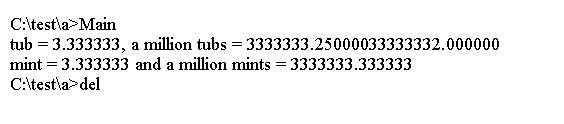
上面的代码生成以下结果。
浮点常量
默认情况下,8.24和2.4E8的浮点常量是double类型。
如果创建一个常量为float类型,则使用f或F后缀。
对于long double类型,您可以使用l或L后缀。
以下是一些示例:
1.234f         // a float constant
2.45E20F       // a float constant
2.345324E28    // a double constant
2.2L           // a long double constant