
C++ 函数重载
学习C++ - C++函数重载
函数多态性(也称为函数重载)允许我们使用不同数量的参数来调用相同的函数。
函数重载可以创建具有相同名称的多个函数。
多态性意味着具有许多形式。
函数重载的关键是函数的参数列表,也称为函数签名。
如果两个函数以相同的顺序使用相同数量和类型的参数,则它们具有相同的签名。变量名称并不重要。
只要函数具有不同的签名,C++就可以使用相同的名称定义两个函数。
参数的数量或参数的类型,或两者都有所不同。
例子
例如,您可以使用以下原型定义一组print()函数:
void print(const char * str, int width);  // #1
void print(double d, int width);          // #2
void print(long l, int width);            // #3
void print(int i, int width);             // #4
void print(const char *str);              // #5
当您使用print()函数时,编译器会将您的使用与具有相同签名的原型相匹配:
print("a", 15);         // use #1
print("a");             // use #5
print(2020.0, 11);      // use #2
print(2020, 12);        // use #4
print(2020L, 15);       // use #3
例子
// Overloaded functions.
#include <iostream>
using namespace std;

// function square for int values
int square( int x )
{
    cout << "square of integer " << x << " is ";
    return x * x;
} // end function square with int argument

// function square for double values
double square( double y )
{
    cout << "square of double " << y << " is ";
    return y * y;
} // end function square with double argument

int main()
{
    cout << square( 7 ); // calls int version
    cout << endl;
    cout << square( 7.5 ); // calls double version
    cout << endl;
}
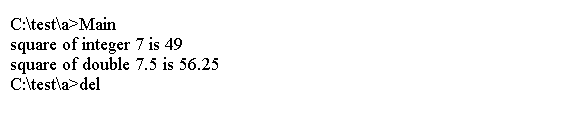
上面的代码生成以下结果。
注意
以下签名不能共存。
double cube(double x);
double cube(double & x);
函数匹配过程确定了常量和非常量变量之间的区别如下。
void d(char * bits);          // overloaded
void d(const char *cbits);   // overloaded
函数返回类型不是函数签名的一部分。
例如,以下两个声明是不兼容的:
  long g(int n, float m);    // same signatures,
double g(int n, float m);    // hence not allowed