
Spring教程 - 弹簧列表属性
Spring教程 - 弹簧列表属性
我们可以将值或值列表填充到Spring xml配置文件中定义的Java bean。
我们可以将值或值列表填充到Spring xml配置文件中定义的Java bean。...
Java Bean
为了展示如何使用xml配置文件来填充集合属性,我们定义了一个具有四个集合属性的Customer对象。
package com.www.w3cschool.cnmon;
import java.util.ArrayList;
import java.util.List;
public class Customer
{
  private List<Object> lists = new ArrayList<Object>();
    public String toString(){
      return lists.toString();
    }
  public List<Object> getLists() {
    return lists;
  }
  public void setLists(List<Object> lists) {
    this.lists = lists;
  }
}
Person Java Bean
package com.www.w3cschool.cnmon;

public class Person {
  private String name;
  private int age;
  private String address;

  public String getName() {
    return name;
  }

  public void setName(String name) {
    this.name = name;
  }

  public int getAge() {
    return age;
  }

  public void setAge(int age) {
    this.age = age;
  }

  public String getAddress() {
    return address;
  }

  public void setAddress(String address) {
    this.address = address;
  }

  @Override
  public String toString() {
    return "Person [name=" + name + ", age=" + age + ", address=" + address
        + "]";
  }

}
列表
以下代码显示如何将数据填充到java.util.List类型化属性。
代码填充三个值。 第一个是硬编码值1.第二个是一个bean参考。 我们必须在某处定义PersonBean,以便在此处使用它。 第三个是bean定义与属性设置。
...
<property name="lists">
    <list>
      <value>1</value>
      <ref bean="PersonBean" />
      <bean class="com.www.w3cschool.cnmon.Person">
        <property name="name" value="java2sList" />
        <property name="address" value="address" />
        <property name="age" value="28" />
      </bean>
    </list>
</property>
...
例子
Full Spring的bean配置文件。
<beans xmlns="http://www.springframework.org/schema/beans"
  xmlns:xsi="http://www.w3.org/2001/XMLSchema-instance"
  xsi:schemaLocation="http://www.springframework.org/schema/beans
  http://www.springframework.org/schema/beans/spring-beans-2.5.xsd">
  <bean id="CustomerBean" class="com.www.w3cschool.cnmon.Customer">
    <!-- java.util.List -->
    <property name="lists">
      <list>
        <value>1</value>
        <ref bean="PersonBean" />
        <bean class="com.www.w3cschool.cnmon.Person">
          <property name="name" value="java2sList" />
          <property name="address" value="address" />
          <property name="age" value="28" />
        </bean>
      </list>
    </property>
  </bean>
  <bean id="PersonBean" class="com.www.w3cschool.cnmon.Person">
    <property name="name" value="java2s1" />
    <property name="address" value="address 1" />
    <property name="age" value="28" />
  </bean>
</beans>
下面是加载和运行配置的代码。
package com.www.w3cschool.cnmon;
import org.springframework.context.ApplicationContext;
import org.springframework.context.support.ClassPathXmlApplicationContext;
public class App
{
    public static void main( String[] args )
    {
      ApplicationContext context = new ClassPathXmlApplicationContext("SpringBeans.xml");
      Customer cust = (Customer)context.getBean("CustomerBean");
      System.out.println(cust);
    }
}
输出
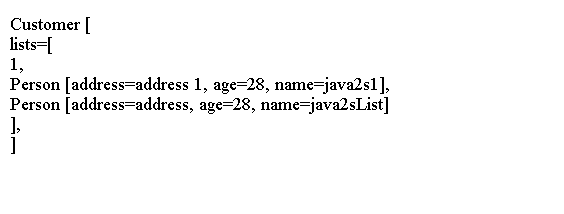
Download Java2s_Spring_List_Properties.zip
ListFactoryBean
ListFactoryBean类可以使用ArrayList或创建一个具体的List集合类LinkedList在Spring的bean配置文件中,然后我们可以注入创建的列表对象到我们的Java bean。
这里是Java bean类。
package com.www.w3cschool.cnmon;
import java.util.ArrayList;
import java.util.List;
public class Customer
{
  private List<Object> lists = new ArrayList<Object>();
    public String toString(){
      return lists.toString();
    }
  public List<Object> getLists() {
    return lists;
  }
  public void setLists(List<Object> lists) {
    this.lists = lists;
  }
}
这里是Spring的bean配置文件。
<beans xmlns="http://www.springframework.org/schema/beans"
  xmlns:xsi="http://www.w3.org/2001/XMLSchema-instance"
  xsi:schemaLocation="http://www.springframework.org/schema/beans
  http://www.springframework.org/schema/beans/spring-beans-2.5.xsd">
 //from w w  w. ja  va 2 s.com
  <bean id="CustomerBean" class="com.www.w3cschool.cnmon.Customer">
    <property name="lists">
      <bean class="org.springframework.beans.factory.config.ListFactoryBean">
        <property name="targetListClass">
          <value>java.util.ArrayList</value>
        </property>
        <property name="sourceList">
          <list>
            <value>1</value>
            <value>2</value>
            <value>3</value>
          </list>
        </property>
      </bean>
    </property>
  </bean>
</beans>
Download Java2s_Spring_ListFactoryBean.zip
util模式
我们还可以使用util模式和< util:list> 以将数据填充到列表中。
<beans xmlns="http://www.springframework.org/schema/beans"
  xmlns:xsi="http://www.w3.org/2001/XMLSchema-instance"
  xmlns:util="http://www.springframework.org/schema/util"
  xsi:schemaLocation="http://www.springframework.org/schema/beans
  http://www.springframework.org/schema/beans/spring-beans-2.5.xsd
  http://www.springframework.org/schema/util
  http://www.springframework.org/schema/util/spring-util-2.5.xsd">
  <bean id="CustomerBean" class="com.www.w3cschool.cnmon.Customer">
    <property name="lists">
      <util:list list-class="java.util.ArrayList">
        <value>1</value>
        <value>2</value>
        <value>3</value>
      </util:list>
    </property>
  </bean>
</beans>
Download Java2s_Spring_util_List.zip
我们还可以使用util模式和< util:list> 以将数据填充到列表中。...
package com.www.w3cschool.cnmon;

import org.springframework.context.ApplicationContext;
import org.springframework.context.support.ClassPathXmlApplicationContext;

public class App {
  public static void main(String[] args) {
    ApplicationContext context = new ClassPathXmlApplicationContext(
        "SpringBeans.xml");

    Customer cust = (Customer) context.getBean("CustomerBean");
    System.out.println(cust);

  }
}